The Difference Between Running Software and Trusting It in Production
Jan 24, 2026
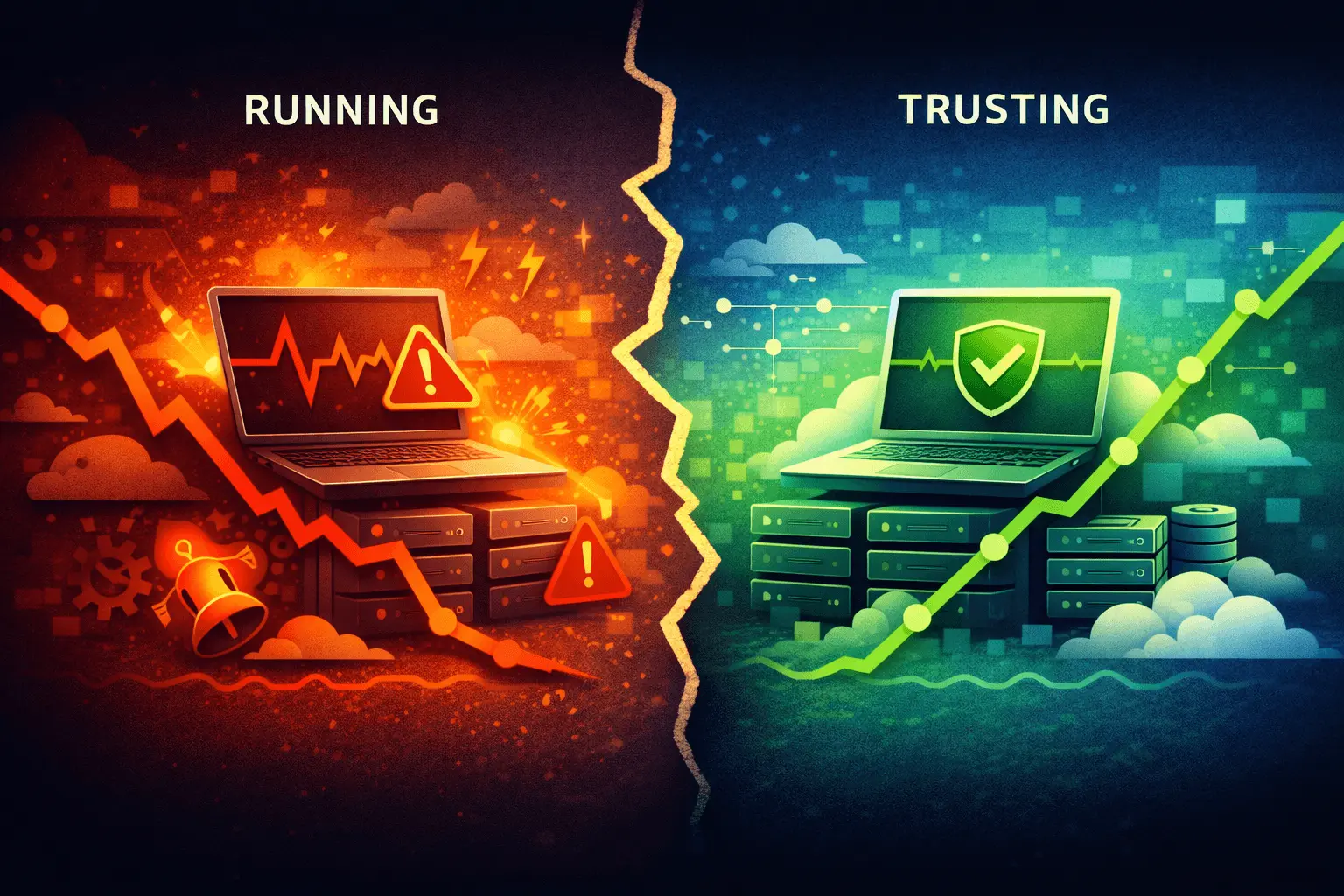
Most software systems are running.
Very few are truly trusted.
At first glance, that distinction sounds subtle. After all, if the application is up, users can log in, and revenue is flowing, what’s the problem? From the outside, running and trusting look identical.
From the inside, they feel completely different.
Teams that merely run software live in a constant state of low-grade anxiety. Teams that trust their production systems operate with calm, confidence, and control. The difference between the two has nothing to do with tools, cloud providers, or how modern the stack is. It has everything to do with how production is understood and managed.
What It Means to "Run" Software in Production
Running software is the default state for most organisations.
The system is deployed. Servers are online. Alerts exist. When something breaks, someone responds. Customers may complain occasionally, but things usually recover. On paper, everything looks fine.
Yet beneath the surface, running software often feels like babysitting it.
Releases are stressful, even small ones. There’s hesitation before deployments, followed by anxious monitoring afterward. Certain parts of the system are avoided because “they tend to cause issues.” Background processes are left alone because touching them feels risky. When incidents happen, fixes are applied quickly, but rarely with confidence that the root cause is fully understood.
Running software means the system works, but only as long as nothing unexpected happens.
And in production, something unexpected always happens eventually.
What It Means to Trust Software in Production
Trusting software is different.
When teams trust production, they don’t assume perfection. They assume behavior. They understand how the system reacts under stress, what failure looks like, and how recovery happens.
A trusted system does not rely on heroics. When something goes wrong, the response is measured, not frantic. There are known failure modes, and the team recognises which ones matter and which ones are noise.
Trust does not come from optimism. It comes from familiarity.
Teams that trust their systems know which parts are fragile, which are resilient, and which are quietly becoming risky. They deploy with awareness rather than hope. Production becomes something they manage deliberately, not something they brace themselves against.
Why Most Teams Never Reach Trust
The gap between running and trusting software is rarely intentional. It forms slowly, over time.
As systems grow, complexity accumulates. Features pile up. Integrations increase. Data volumes change. Decisions that made sense early on become liabilities later. But because these changes are incremental, they don’t trigger alarm bells.
Instead, teams adapt informally.
They create unwritten rules:
“Don’t deploy on Fridays.”
“Restart it if it behaves strangely.”
“That job fails sometimes, just rerun it.”
Each workaround keeps the system running — but each one quietly erodes trust.
Over time, production becomes something teams cope with rather than understand.
The Role of Incidents in Eroding Trust
Incidents play a major role in shaping how teams feel about production.
In systems that are merely running, incidents tend to be surprising. Something breaks in a way nobody predicted. The fix works, but the explanation feels incomplete. There’s a lingering sense that the same issue could reappear in a different form.
This unpredictability is what destroys trust.
It’s not the frequency of incidents that matters most — it’s their nature. A rare but confusing incident can be more damaging than frequent, well-understood failures. When teams can’t explain why something happened, confidence drops.
Eventually, production starts to feel like a black box that occasionally misbehaves.
Why Uptime Is Not the Same as Trust
One of the biggest misconceptions about production is equating uptime with reliability.
A system can be “up” and still be deeply untrustworthy.
Data can be inconsistent. Background processes can lag behind silently. Edge cases can pile up. Performance can degrade slowly enough that alerts never fire, but users feel it anyway.
From an infrastructure perspective, everything looks healthy. From a business perspective, things feel off.
Trust is not about availability alone. It’s about correctness, predictability, and confidence that the system is doing what it’s supposed to do — even when conditions aren’t ideal.
The Psychological Cost of Not Trusting Production
Lack of trust in production has a real human cost.
Engineers become cautious to the point of paralysis. Simple changes take longer because everyone fears unintended consequences. Knowledge concentrates around a few people who “know how production behaves,” creating risk and burnout.
Leaders sense this tension even if they can’t name it. Roadmaps slip. Releases slow down. Confidence in the system — and sometimes in the team — quietly erodes.
Ironically, teams that don’t trust production often move slower than those who do, even if they appear more reactive.
How Trust Is Actually Built
Trust in production is not built through declarations or documentation. It’s built through consistent behavior over time.
It comes from observing how systems fail and making those failures less surprising. From noticing small degradations early instead of waiting for outages. From understanding which issues are structural and which are incidental.
Most importantly, trust comes from ownership.
When someone is continuously responsible for how production behaves — not just when it’s broken, but when it’s quiet — systems become more predictable. Patterns emerge. Risks are addressed before they escalate. Production stops feeling random.
This kind of trust cannot be installed. It has to be maintained.
Running Is Easy. Trusting Is Deliberate.
Every organisation runs software. That’s table stakes.
Trusting software requires intention. It requires treating production as a system that evolves, not a destination that’s been reached. It requires acknowledging that stability is not the absence of incidents, but the presence of understanding.
Teams that make this shift don’t eliminate problems. They eliminate panic.
And in production, that difference is everything.
Running software keeps the lights on. Trusting it lets you focus on what actually matters.
← Back to blog